
In the race for market share, software development has reached warp speed. With AI-driven tools now generating over 25% of new code at global leaders like Google and Microsoft, the dream of “assembling” software at machine speed is a reality.
But for technical and security leaders, this revolution comes with a hidden cost. We aren’t just shipping features faster; we are shipping automated risk.
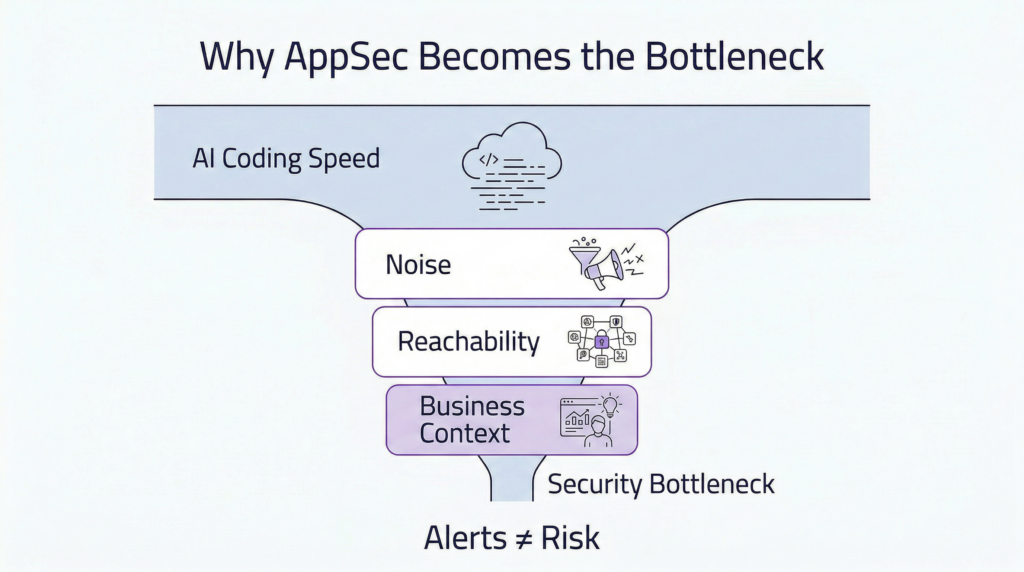
The Illusion of Coverage: Welcome to “Application Security Theatre”
Many organizations fall into the trap of “Application Security Theatre”—the false confidence created by a growing array of scanners and a high volume of findings that lack objective validation.
Current tools (SAST, DAST, MAST, IAST, Pentest) are failing the modern enterprise in three critical ways:
- The Noise Floor is Rising: Traditional tools identify “findings’, not actual risk. They generate thousands of severity labels without context, leading to “alert fatigue” and a total breakdown of trust between security and engineering teams.
- A Lack of Reachability: A “Critical” vulnerability is just a data point unless you know if it is actually reachable and exploitable in your specific architecture.
- No Business Context: Vulnerability counts and heatmaps are not manageable metrics; they lack context, and they don’t speak the language of the boardroom. Leadership needs to know risk and financial exposure, not just a count of CVEs.
Evolving Beyond the Scanner: The Correlated Intelligence Layer
To move from reactive patching to proactive governance, AppSec must evolve into an intelligence layer that correlates, normalizes, prioritizes, and contextualizes real risk across the entire software lifecycle. This is where CyberSagacity steps in.
Through our SATraits™ and SATriage™ platforms, we provide the missing intelligence layer for AI-accelerated delivery:
1. Eliminate the Noise (SATraits™)
SATraits uses decades of empirical data and statistical risk modeling to quantify tool accuracy. It identifies false positives and overlaps across your toolchain, ensuring your engineers only spend capacity on high-confidence signals.
2. Prioritize by Material Impact (SATriage™)
Not all defects carry the same weight. SATriage ranks vulnerabilities 1-to-N by true risk and exploitability. Most importantly, it maps these technical defects to expected financial loss and regulatory frameworks like DORA, PCI, HIPAA, and GDPR.

The Outcome: Defensible Governance and Secure Velocity
For mid-market and enterprise leaders, the goal isn’t just “more security”—it’s security you can prove. By shifting from alerts to action, CyberSagacity enables:
- Developer Productivity: Teams fix the small fraction of defects that materially reduce risk, removing friction from the CI/CD pipeline.
- Audit-Ready Evidence: Shift governance conversations from reactive explanations to informed trade-off decisions with data that auditors and boards can trust.
- Confidence at Scale: Harness AI-accelerated innovation without the unmanaged liability of AI-generated vulnerabilities.
Is your AppSec program measuring risk—or just activity?
The era of Application Security Theatre is over. It’s time to move toward an evidence-based approach that protects both your code and your business value.
Ready to see beyond the noise? [Schedule a demo of SATraits and SATriage today].