
For decades, cybersecurity professionals and best-practices have conditioned organizations to think about attackers in a particular way.
An anonymous adversary sits somewhere on the Internet, probing firewalls, scanning open ports, bypassing intrusion detection systems, exploiting network services, and eventually “breaking into” the enterprise.
That certainly happens.
But it is far from the only way modern systems are compromised.
In fact, many of today’s most damaging attacks never require bypassing the network perimeter at all.
The attacker simply logs in.
The Myth of the Perimeter
Modern enterprises have invested heavily in perimeter security:
- Next-generation firewalls
- Intrusion Detection and Prevention Systems (IDS/IPS)
- Secure Web Gateways
- VPNs and Zero Trust architectures
- Endpoint Detection & Response (EDR)
- Network monitoring and threat intelligence
These technologies remain essential. They stop countless attacks every day.
However, they are designed primarily to distinguish malicious traffic from legitimate traffic crossing the network boundary.
The challenge is that today’s applications are intentionally designed to welcome legitimate users:
- Customers register.
- Partners authenticate.
- Developers access APIs.
- Suppliers upload information.
- Employees log in remotely.
- Applications communicate with one another.
Once authenticated, these users are expected to interact with the application.
If the application itself contains exploitable weaknesses, the network perimeter has already served its purpose. The attacker is no longer trying to get into the network — they are interacting with the application exactly as it was designed to allow.
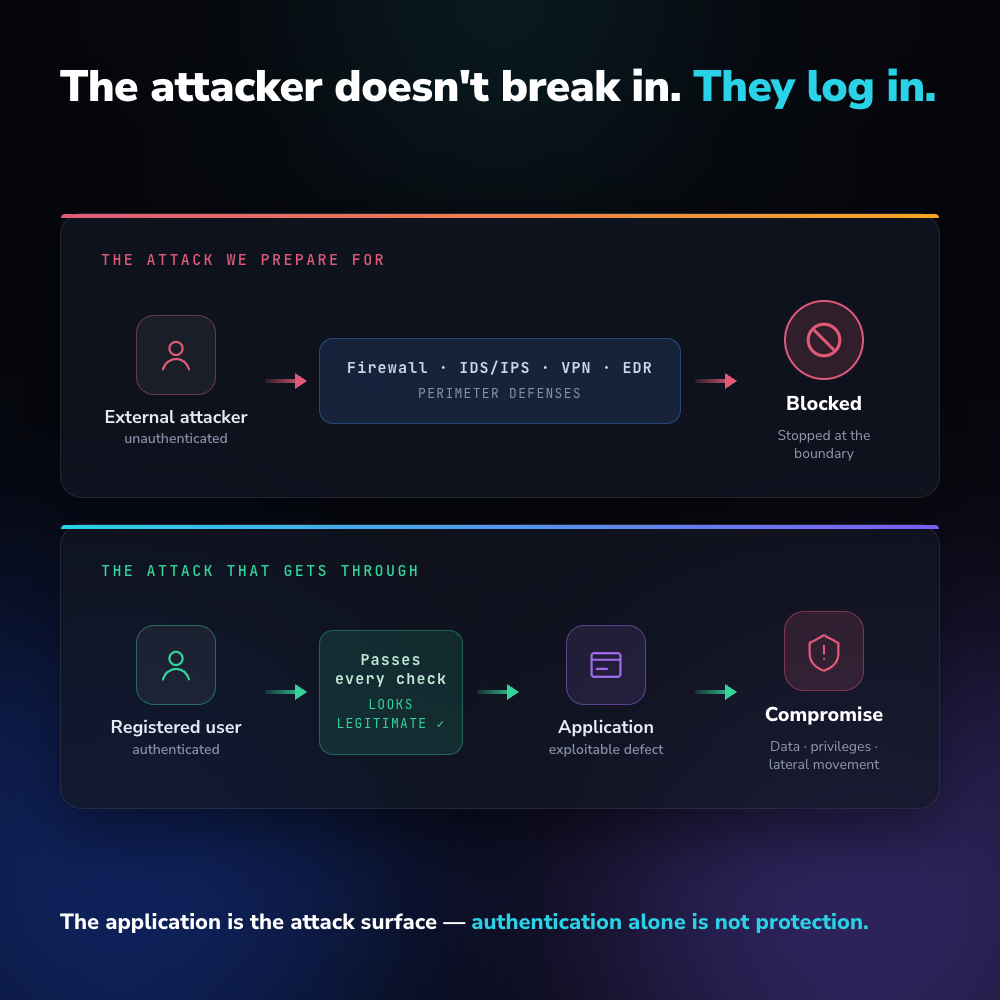
Legitimate Access Can Become Malicious Activity
Imagine an attacker who creates a standard customer account on an e-commerce platform.
No firewall is bypassed.
No VPN is compromised.
No intrusion detection alert is triggered.
The attacker simply completes the registration process like every other customer.
Now consider that one application input contains an injection vulnerability.
Instead of submitting expected data, the attacker supplies carefully crafted input designed to manipulate backend processing.
Depending on the weakness, the attacker may be able to:
- Read sensitive information
- Modify application data
- Execute unauthorized commands
- Escalate privileges
- Install malware
- Disrupt business operations
- Move laterally into connected systems
From the network’s perspective, everything appears legitimate. The requests originate from an authenticated user following the expected application workflow.
The compromise occurred because of weaknesses inside the application — not because the network perimeter failed.
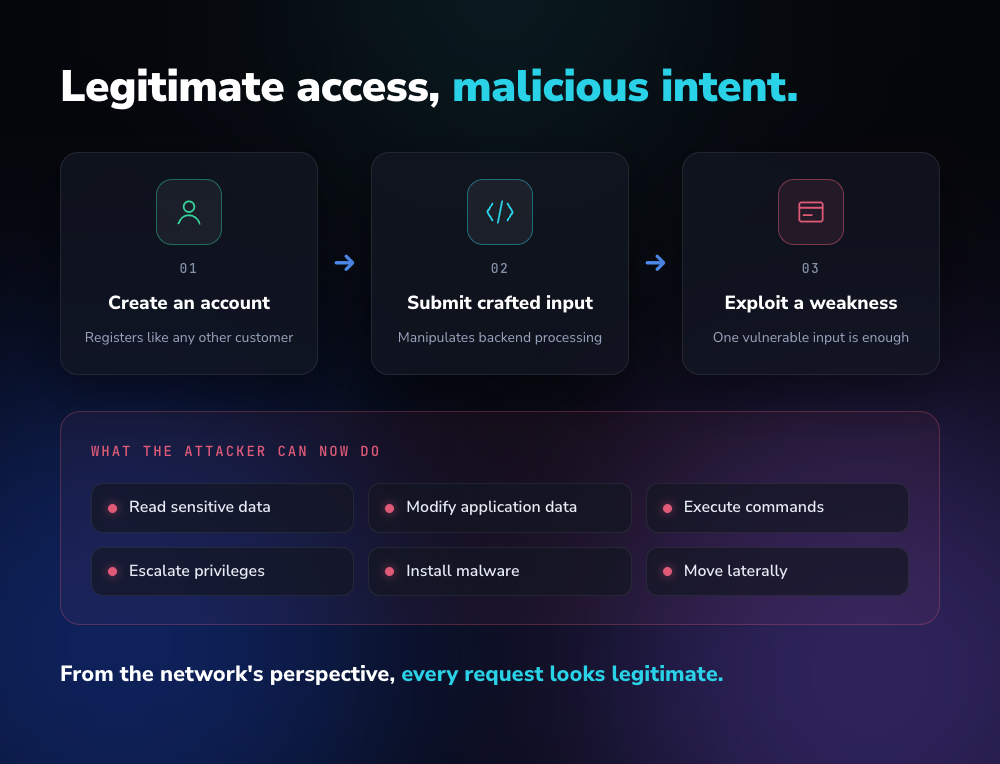
The Application Is Now the Attack Surface
This distinction has become increasingly important. Organizations are exposing more applications than ever:
- Customer portals
- Mobile applications
- SaaS platforms
- APIs
- Partner integrations
- AI-powered services
- Developer self-service portals
Every authenticated user represents a potential interaction with application code. Every interaction exercises business logic.
Every business process depends on software behaving exactly as intended.
When defects exist in that software, authentication alone does not provide protection.
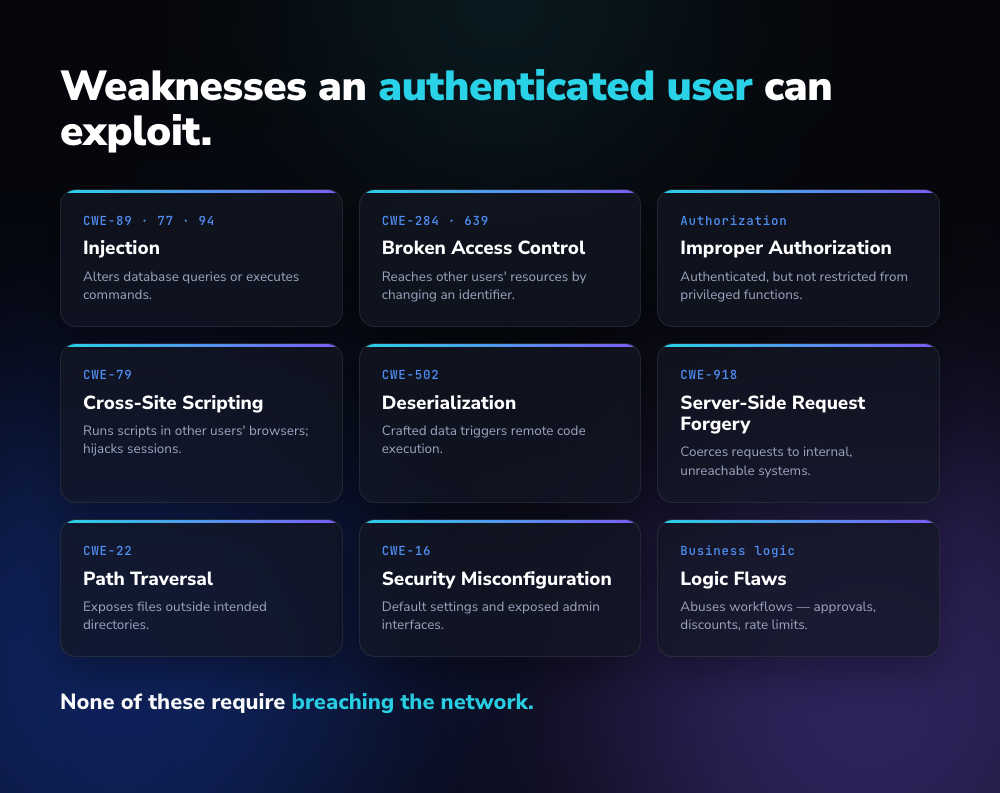
Common Weaknesses That Don’t Require Breaching the Network
Many of the most serious software weaknesses can be exploited by users who already possess legitimate credentials.
Examples include:
Injection Weaknesses (CWE-89, CWE-77, CWE-94)
Poor input validation can allow attackers to alter database queries, execute commands, or manipulate application behavior.
Broken Access Control (CWE-284, CWE-639)
An authenticated user gains access to resources belonging to other users simply by modifying identifiers or requests.
Improper Authorization
The user is authenticated but is not adequately restricted from administrative or privileged functions.
Cross-Site Scripting (CWE-79)
Malicious scripts execute within other users’ browsers, enabling credential theft, session hijacking, or unauthorized actions.
Deserialization Vulnerabilities (CWE-502)
Specially crafted application data can trigger unexpected execution paths or remote code execution.
Server-Side Request Forgery (CWE-918)
Applications can be manipulated into making unauthorized requests to internal systems that are otherwise inaccessible.
Path Traversal (CWE-22)
Applications expose files outside intended directories through improper validation of file paths.
Security Misconfiguration (CWE-16)
Default settings, excessive permissions, exposed administration interfaces, or unnecessary services provide attackers with opportunities that require no network intrusion.
Logic Flaws
Some of the most damaging attacks exploit weaknesses in workflow rather than software bugs — for example, bypassing approval processes, abusing discount logic, manipulating financial transactions, or automating functions that were intended to be rate-limited.
None of these attacks necessarily begin with a compromised firewall. They begin with software that behaves differently than its designers intended.
AI Doesn’t Change the Problem — It Amplifies It
AI-assisted software development is dramatically increasing development velocity. Organizations are generating more code than ever before.
Open-source components continue to expand software supply chains.
Developers increasingly rely on AI-generated recommendations for implementation and remediation.
Regardless of whether code is written by a human developer, incorporated from open-source projects, or generated by an AI coding assistant, one fact remains unchanged: Software defects remain software defects.
Attackers are indifferent to their origin. They care only that they are exploitable.
As development accelerates, organizations face an increasingly difficult challenge — not simply identifying vulnerabilities, but determining which findings are accurate, which matter operationally, and which genuinely threaten the business.
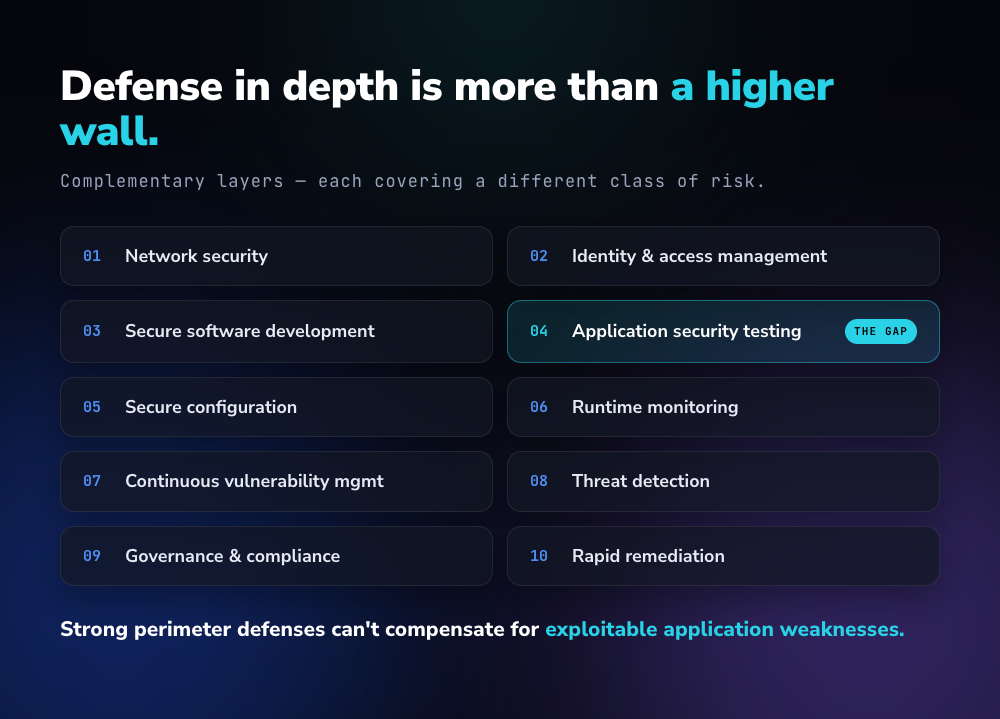
Defense in Depth Means More Than Building a Higher Wall
Defense in depth has never meant relying on a single security control.
It means building complementary layers that continue protecting the organization even when another layer is bypassed.
That includes:
- Network security
- Identity and access management
- Secure software development
- Application security testing
- Secure configuration
- Runtime monitoring
- Continuous vulnerability management
- Threat detection
- Governance and compliance
- Rapid remediation
Each layer addresses a different class of risk.
Strong perimeter defenses cannot compensate for exploitable application weaknesses.
Likewise, perfect software cannot eliminate the need for robust network protections.
Effective security requires both.
The Next Evolution Is Application Security Intelligence
Application security has traditionally focused on finding vulnerabilities.
The harder problem is determining which findings actually matter.
Organizations today face millions of security findings, conflicting scanner outputs, AI-generated recommendations, and limited remediation resources.
The challenge is no longer simply detecting defects.
It is making accurate, consistent, and economically informed security decisions. This is precisely where a new layer of security architecture is emerging.
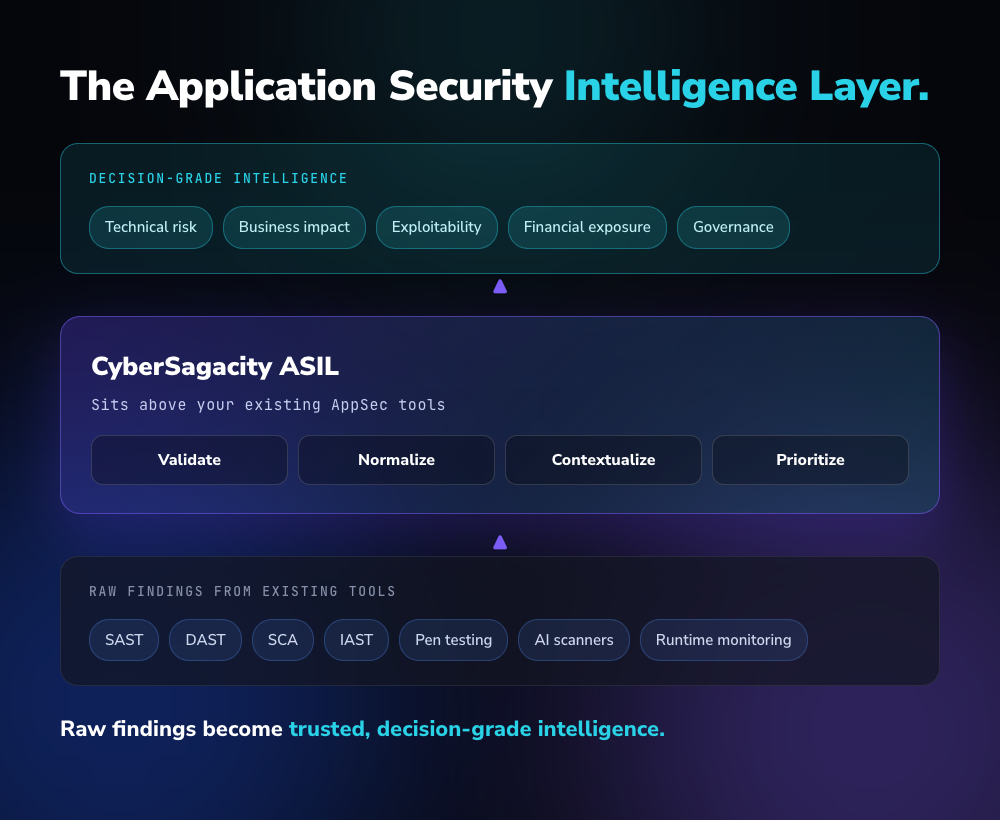
At CyberSagacity, we describe this as the Application Security Intelligence Layer (ASIL) — an intelligence layer that sits above traditional security testing technologies to validate, normalize, contextualize, and prioritize application security findings.
Rather than replacing existing AppSec tools, ASIL enables organizations to derive greater value from them by transforming raw findings into trusted, decision-grade intelligence that reflects technical risk, business impact, exploitability, financial exposure, and governance requirements.
As AI continues reshaping software development, this intelligence layer becomes increasingly important. The question is no longer where the code came from — it is whether the resulting software can be trusted.
Final Thought
Not every cyber incident begins with a network breach.
Many begin with a valid username and password.
They exploit weaknesses in application logic, authorization, configuration, or software design — areas where perimeter defenses offer little protection because the interaction itself appears legitimate.
The future of cybersecurity is not choosing between network security and application security.
It is recognizing that true defense in depth requires both.
Organizations that protect only the perimeter leave themselves exposed from within. Those that combine strong network controls with trusted application security intelligence are far better positioned to defend modern software — regardless of whether the code was written by a developer, assembled from open-source components, or generated by AI.